
Updated new base years for national accounts and other macro-indicators are expected to come into effect from January-February 2026, coinciding with the first and second advance estimates of national income for FY26, senior official sources aware of the development told Business Standard. "The statistics ministry set up the Advisory Committee on National Accounts Statistics (ACNAS) earlier this week. "It will advise on the base year for GDP (gross domestic product) and its alignment with other macro-indicators.

RBI's projection of retail inflation at 6.8 per cent in the current fiscal is neither too high to deter private consumption, nor so low as to weaken inducement to invest, the Economic Survey said on Tuesday. However, entrenched inflation may prolong the tightening cycle and therefore, borrowing costs may stay 'higher for longer', it said. The Economic Survey 2022-23 was tabled in Parliament by Finance Minister Nirmala Sitharaman.

The wholesale price-based inflation in February rose to 13.11 per cent on hardening of prices of crude oil and non-food items, even though food articles softened. After two months of mild easing, WPI inflation accelerated in February and remained in double digits for the 11th consecutive month, beginning April 2021. WPI inflation last month was 12.96 per cent, while in February last year, it was 4.83 per cent. The rise in crude oil and natural gas prices after the Russian invasion of Ukraine, beginning February 24, has put pressure on the wholesale price index, even though food articles saw softening across categories of vegetables to pulses to protein-rich items.

Inflation declined marginally to 4.61 per cent for the week ended July 29, from 4.67 per cent in the previous week mainly due to cheaper food items, including milk.
Inflation moved up to 7.23 per cent in April on account of spurt in prices of vegetables, meat, milk and pulses, although onion and fruits showed a declining trend.

Data on primary and fuel items would continue to be released on weekly basis.
Inflation fell to 4.06 per cent for the week ended March 18 as against 4.28 per cent in the preceding week, mainly due to cheaper food articles including vegetables and non-food items.
Inflation declined marginally to 4.91 per cent for the week ended August 19 from 4.92 per cent in the previous week despite increase in prices of minerals, food and manufactured items.
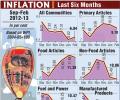
The wholesale price index, the main inflation indicator, rose an annual 6.84 per cent in February, higher than the 6.54 per cent rise estimated by analysts.
Fruits and vegetables, pulses, eggs meat and fish got expensive during the period, while some manufactured food articles like atta, maida got cheaper. Among other manufactured items, prices of cement, lead ingot and some basic heavy inorganic chemicals got dearer.

Benchmark Sensex declined 224 points on Wednesday, snapping its four-session winning streak, mainly due to sell-off in IT and pharma counters amid rising concerns over possible aggressive interest rate hikes to tame high inflation. The 30-share index rebounded more than 1,200 points from the early lows before settling at 60,346.97 points, a total loss of 224.11 points or 0.37 per cent compared to Tuesday's closing level. The broader NSE Nifty closed lower 66.30 points or 0.37 per cent at 18,003.75 points.

Pulses inflation remained stubborn at 35.56 per cent.
In December, the index fell a provisional 0.73 per cent.

High vegetable prices are expected to keep food inflation firm in the months to come.

The hardening of the Wholesale Price Index follows an uptick in retail inflation.

Equity markets would take cues from domestic inflation data announcement, global trends and trading activity of foreign investors in a holiday-shortened week ahead, analysts said. Markets would remain closed on Tuesday for 'Diwali Balipratipada'. "As we enter a truncated week with Muhurat trading on Sunday, global cues will play a pivotal role in shaping the market direction.
Inflation rose to 4.77 per cent for the week ended September 23 from 4.56 per cent in the previous week, mainly due to spurt in prices of pulses, wheat and iron ore.
Wholesale prices-based inflation rate rose to a ten-month high of 5.02 per cent for the week ended February 23, as food and some manufactured products turned costly. Inflation rate for the previous week was at 4.89 per cent and was last above five per cent on May 19, 2007 (5.06 per cent).

Quarterly earnings of corporates, trading activity of foreign investors and inflation data are the key factors that are expected to drive the momentum in the equity markets this week, analysts said.

The wholesale price-based inflation surged to more than a decade high of 14.23 per cent in November, mainly due to hardening of prices of mineral oils, basic metals, crude petroleum and natural gas. WPI inflation has remained in double digits for eight consecutive months beginning April. Inflation in October this year was at 12.54 per cent, while in November 2020 it was at 2.29 per cent. "The high rate of inflation in November 2021, is primarily due to rise in prices of mineral oils, basic metals, crude petroleum & natural gas, chemicals and chemical products, food products etc as compared to the corresponding month of the previous year," the commerce and industry ministry said in a statement on Tuesday.

This increases expectations that RBI may cut rates later this month.

The government has been stringent with pricing changes. Prices of 651 essential medicines came down from April 1, 2023 by 6.73 per cent with the government capping ceiling prices of these drugs.

The median forecast for wholesale price index-based inflation in the first quarter of 2010/11 is at 10.4 per cent, according to Reserve Bank of India's survey, higher than 9.5 per cent in the previous survey.
Wholesale price rise slowed down to 3.51 per cent for the week ended April 1 even though essential items like vegetables; industrial fuels and some manufactured products became costlier.

Investors' confidence has been revived in recent weeks on the likelihood the elections will usher in a new government.
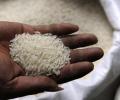
A 6-7 million tonnes shortfall in rice production due to a fall in paddy sowing area is likely to keep rice prices at elevated levels, adding to the inflationary pressure that the slowing economy is already grappling with. Elevated food prices, including that of cereals, had led to retail inflation reversing a three-month declining trend, to touch 7 per cent in August. Similarly, the wholesale price inflation, which declined to 11-month low, also showed price pressures from cereals resulting from wheat output being impacted by severe heat waves in some parts of the country.

'We will be very, very proactive in providing whatever liquidity requirements are needed.'

Tomato prices have been on the boil for more than a month. Data from major cities show that the spike has been between 125 and 150 per cent at the wholesale level. Soaring vegetable prices, including tomatoes, pushed the retail inflation rate to a nine-month high of 5.49 per cent in September, according to government data. Though reports say prices are expected to come down in the next few weeks after supplies improve from Madhya Pradesh and Himachal Pradesh, how long will the respite last is anybody's guess.

Motorists using expressways will have to shell out more from Monday as the National Highways Authority of India (NHAI) has decided to hike tolls across the country by an average of 5 per cent. The annual revision of highway user fee, which is expected to be in the range of average 5 per cent, was earlier to come into effect on April 1. But the hike was deferred due to the Lok Sabha elections.
The wholesale price index's annual rise compared with a 7 per cent jump forecast by economists in a Reuters poll.

Vegetable inflation softened to 24.76 per cent in June, down from 33.15 per cent in the previous month. Inflation in potato was (-) 24.27 per cent, against (-) 23.36 per cent in May.

Price of potato, a daily consumable vegetable, rose 58.78 per cent during the month
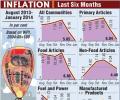
This is the second straight month of decline in wholesale price based inflation.

The Central bank primarily factors Consumer Price Index while deciding on policy rate.
Inflation further rose to 4.74 per cent for the week ended May 20 from 4.32 per cent in the previous week mainly due to increase in the prices of food, non-food, minerals and some manufactured items.

The RBI gauges both measures of inflation when deciding on monetary policy,

Emerging markets such as India have always run higher inflation rates than developed economies such as the US and countries of Western Europe. But for the first time in the past 30 years, the US reported a higher consumer price inflation (CPI) rate than India in five consecutive months. The US reported a CPI rate of 7.5 per cent in January 2022 against 6.01 per cent in India and analysts expect the trend to continue for at least a few months more

Inflation in food articles, fuel and power contracted in July.

According to the global financial services major, inflation may remain sticky, with a possible El Nino effect on the monsoon likely to push up food prices and geopolitical uncertainties seen pumping up global commodity rates.
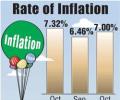
Food prices rose 18.19 per cent year-on-year in October, slower than an annual rise of 18.4 per cent in September.
 © 2026 Rediff.com - Advertise with us - Disclaimer - Privacy Policy - Sitemap - Feedback - About us - Terms of use - Grievances